

DTP are pleased to share our latest DTP Briefing which we prepare on a quarterly basis. The aim of our briefings is to provide useful updates on relevant social housing sector content, highlight where DTP can assist in providing support and advice on any issues arising from these and to publicise recent DTP social media activity, future events, and content.
There’s a lot of activity across the social housing sector to keep abreast of, and with the Government announcement yesterday around Social and Affordable Housing Renewal, this is a longer than usual briefing.
As always, we welcome feedback for future content – please email [email protected] with any thoughts or suggestions.
If you would like us to remove your name and email from our mailing list at any point, please let us know by contacting [email protected].
DTP was set up 20 years ago by David Tolson and has always aimed to:
We have now become an Employee Owned Business, through the creation of an Employee Ownership Trust (EOT). EOTs were introduced to promote employee ownership and there are now over 2,500 in operation. The EOT now owns the shares in DTP, but DTP itself continues as before with same leadership, structure, services, values and commitment to our clients.
The development reflects our values and will assist in the achievement of the aims above. It should enhance our recruitment/retention and promote business continuity which we believe will strengthen our relationships with clients and the services we deliver.
DTP’s values are:
Focus on People
We take time to understand our clients and build trusted relationships
Tailored Solutions
We listen to our clients’ needs and provide tailored, high quality support and solutions
Straightforward Approach
We are professional and respectful and bring a measured and pragmatic approach to our work
Expert Advice
Our team are experts in their field and work together in a holistic way to provide added value to our clients
Honest Opinion
We are honest and open, with a supportive approach, providing constructive challenge where needed
If you’d like to know more about our journey as an EOT, please let us know.
We continue to see substantial activity and change within the sector. We have highlighted below the key areas we feel our clients and mailing list contacts would be most interested to hear about.
Treasury and Business Planning Update
Many of you will be in the process of setting budgets and updating business plans for 2026-27, a process made all the more difficult due to uncertainty around some key government decisions. On Wednesday 28 January 2026, the Government published its Policy Paper ‘January 2026 progress update: Delivering a decade of renewal for social and affordable housing’. This provides much needed clarity on a variety of aspects as well as more general direction in travel in other areas. We have provided a full summary and link to the document in a separate section below.
We have had some much-awaited clarity this week on rent convergence, with Matthew Pennycook, Minister for Housing and Planning, announcing that housing providers will be able to increase rents by £1 per week above CPI + 1% from April 2027, and by £2 per above this level from April 2028. Increases are permitted to go up to formula rent levels only. DTP can provide guidance and support in modelling the impact of rent convergence within business plans. Please contact Senior Consultant Andy Chapman [email protected].
The Policy Paper also includes details of the new Decent Homes Standard which will allow RPs to develop their business plans to account for the new requirements. The condition of components, rather than age, will be the primary factor in determining compliance. This is a substantial shift that will require a significant rethink of how housing associations approach and cost asset management.
In the Spending Review last year, the government announced £2.5bn of low interest debt to help accelerate the supply of new homes. The policy paper has offered clarity on how this will be structured, with interest rates set at 0.1%- and 25-year maturities. 60% of the debt will be allocated to London and 10% will be available for Section 106, with a competitive bidding process determining the allocation of funds. The government expects the loans to be used to provide additional homes, above and beyond those developed through new grant funding announced next year.
The Regulator of Social Housing (RSH) published its Global Accounts this month, collating financial results from Private Registered Providers of Social Housing (PRPs) for the financial year to 31st March 2025. The numbers show record investment in existing stock, increasing by 14% in the last financial year to £10bn. New supply remained consistent with previous years, with the sector delivering 54,000 homes and spending £14.2bn on new supply. RPs continue to face financial pressure with EBITDA-MRI interest cover remaining below 100%, with debt rising to £105bn.
In November 2025, the Regulator also published an updated ‘Sector Risk Profile ‘(SRP). While the key themes have not significantly changed from previous annual versions, the SRP notes that Registered Providers (RPs) are operating within a low headroom environment with reduced capacity to manage risks making the need for robust governance more crucial than ever.
DTP offers support with business planning, treasury management & funding, financial & strategic risk management, and resilience planning. Please reach out to one of the team to find out more about how we can support you.
Government Policy Paper Summary – ‘January 2026 progress update: Delivering a decade of renewal for social and affordable housing’
The Government published a vital update on Wednesday 28 January 2026, a link to the full document can be found here. We have summarised below the key takeaways:
To support the Government working in close partnership with the sector it will develop a ‘compact’ with National Housing Federation, Local Government Association and other sector bodies. The compact will be overseen by ‘taskforce’ made up of representatives from across the sector, strengthening joint governance and accountability with increased oversight from the Secretary of State.
Applications for the new £39billion Social and Affordable Homes Programme (SAHP) will open in February 2026 with a focus to achieve 300,000 new homes with at least 60% Social Rent. The Government outlined how it will expect a requirement for 100% of first lets under the programme to go to councils under nominations agreements or to rehouse statutory homeless households – part of its plans to support better use of existing legislation, policy and practice around social housing allocation to relieve or prevent homelessness.
The Government wants to create a simpler and more transparent S106 system to tackle drop in demand for S106 properties. All Local Planning Authorities expected to adhere to emergency approach to uncontracted units.
Putting tenant safety and experience at the core of a modernised framework.
The new Decent Homes Standard (DHS) will apply to social and private rented sectors from 2035, prioritising safety, decency and warmth. Condition of components, rather than age, will determine compliance. There will be a more proactive approach to tackling damp and mould, however enhanced home security obligations and mandatory floor covering requirements have been removed following consultation. A full policy statement has been published with further guidance to follow.
All rented social housing properties must meet reformed Energy Performance Certificate (EPC) C requirement by April 2030. To comply, social homes must have an EPC ‘C’ using reformed EPCs, against any one EPC metric, at landlord discretion. A further requirement is to then achieve EPC C against in secondary metric, focusing on carbon emissions & energy use, to be met by 1 April 2039. Full government response to consultation and guidance to follow.
FHS confirmed, requiring new developments to be carbon neutral. Consultation response and specification to be released in Q1 of 2026.
Following introduction of Awaab’s law, the Government is looking at extending the approach to other HHSRS hazards.
Confirmation of Competency and Conduct standards and Social Tenant Access to Information Requirements (STAIRS) from October 2026. Consultation from the Housing Ombudsman on STAIRS and consultation from the RSH on changes to the Transparency, Influence and Accountability Standard as a result of these changes. Commitment to extend Freedom of Information to include Tenant Management Organisations.
Scottish Government Plans to Launch New National Housing Agency
The Scottish Government has announced its intention to create and run a new national agency for housing and land delivery – More Homes Scotland. Further announcements are expected in March to Parliament with a timeline to make the agency operational by 2028/29, subject to the outcome of the Scottish Parliament election in May 2026. Further details can be found here.
RSH Consumer Standards – Outcomes Frameworks
As we are almost halfway through the RSH revised planned inspection programme, and 2-years into working with the RSH’s revised Consumer Standards, we thought it would be helpful to share some thoughts on how RPs are evidencing the outcomes of the Consumer Standards within their respective governance structures.
All RPs, regardless of size or whether they are a Local Authority (LA) or PRP, are required to demonstrate the outcomes of the Consumer Standards. We have seen some varied practice across the sector and whilst there are some commonalities, as can be expected, each RP takes a different approach. This should be appropriate and proportionate to the RP but of course must ensure that it can support compliance with the Standards.
We have worked with several clients to help them build an outcomes framework and one aspect we always encounter is the question around what the right balance of information is to be reported into each body in the Governance structure. This could be a Board or a sub-committee of a PRP or a Housing Board (or similar) within a LA. We’ve also had some good discussions around what counts as appropriate oversight at, for example, Executive or Senior Leadership level and, importantly, what type of information and how much should be made available for customer and tenant scrutiny.
Frequency of reporting and the content of reports are other key areas that can support demonstration of the outcomes of the Consumer Standards. We have helped clients navigate the tricky waters of reporting stock condition, complaints, repairs and maintenance, health and safety, allocations and customer insight – to name but a few.
Our Top Tips to ensure you have a solid outcomes reporting framework are:
We have had the pleasure of working with many C1 clients and helping them prepare for inspection; how to effectively demonstrate service outcomes and the transparency categories of inspection through a robust Consumer Outcomes Framework has been pivotal to this.
If you would like to discuss your Outcomes Framework, test if it is fit for purpose, or chat through the possibility of developing one, please do get in touch with DTP Senior Consultant Diane Carney – [email protected]. DTP also offer a variety of support in providing assurance with compliance with the Consumer Standards more generally.
As noted above, DTP continues to work with a range of providers, for profit and not for profit PRPs, LA RPs and LAs with retained stock or arm’s length management arrangements to support their inspection preparations.
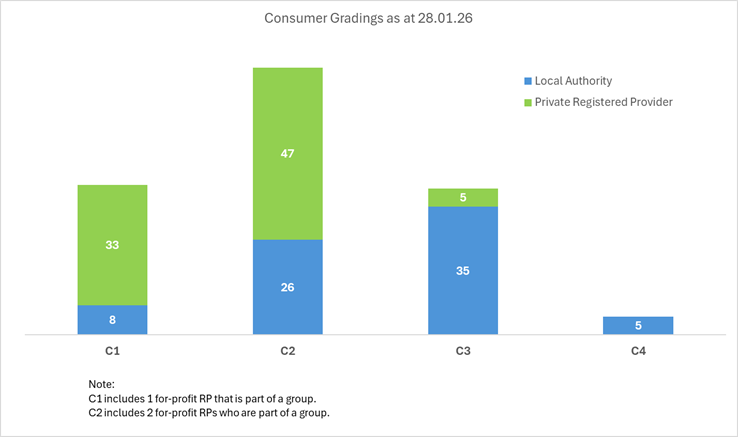
We are very proud of our track record in effectively and flexibly supporting our clients to provide tailored and constructive support which takes an informed, evidenced based view of regulatory compliance. Our clients have provided positive feedback which indicates that we can add value and build confidence in relation to inspection readiness. The most recent judgements (set out in the table below) indicate varying outcomes from inspection. So, if you think that an external, critical friend might be useful, please do look at the case studies on our website and get in touch with Angela Lomax: [email protected] to discuss how our team might help.
Renters’ Rights Act 2025 Update
The Renters’ Rights Act 2025 received Royal Assent on October 27, 2025. Whilst many of its provisions target the Private Rented Sector (PRS), the Act introduces significant changes for RPs also, bringing the greatest reform to tenancies since the Housing Act 1988.
Full details can be found here and we urge providers to consider the following as part of their preparation:
Please get in touch if you require any further support in preparing for the legislative changes.
Social Tenant Access to Information Requirements (STAIRs)
The Government published its Social Tenant Access to Information Requirements (STAIRs) policy statement on 30 September 2025 and the Housing Ombudsman Service is now consulting on its role in relation to STAIRs. So what is STAIRs all about?
Briefly, STAIRs aims to give tenants of PRPs rights to information about the way their landlord manages and delivers services. Local Authority tenants already have this right under the Freedom of Information Act (FoI) but Housing Associations and other PRPs are not subject to FoI. STAIRs will ensure that all social housing tenants have similar rights in this respect.
Senior Consultant, Mags Pearson will be writing a blog on STAIRs, to explore what it means in detail, where the Housing Ombudsman fits in and what providers should be doing to prepare for its introduction. Keep a look out on our LinkedIn page or contact Mags directly for support [email protected]
At DTP, we have a values based approach to our work, providing expert advice in a people focussed way, which delivers tailored solutions. We help our clients improve how they are governed, managed and financed. Our reputation is built on delivering solutions that work in practice and we want to stand out from the competition by blending deep market insight with actionable knowledge, all to achieve outstanding outcomes for your organisation.
Here are a few of examples of feedback from our recent client surveys:
‘The Board are now much clearer about the options available to them and the associated risks and opportunities’
‘We gained the information we needed which we could not have known without DTP’s assistance’
‘Being well prepared for inspection was key to the outcome we achieved which was G1, C1, V2.’
We sometimes get asked about the range of services we offer – to find out more visit our website and ‘what we do’ page here. In summary the services we offer are:
Here is a reminder of some of our most recent webinars, podcasts and DTP Views (with links provided) all aimed at providing valuable insight and sharing good practice. We share these via our social media and on our website.
If you missed our recent webinars you can review the recordings via the links below:
DTP Webinar – Delivering High Quality, Customer Focused Services – Wednesday 28 January 2026
DTP Webinar – Assurance Frameworks for Governing Bodies – Monday 17 November 2025
You can also sign up for DTP’s next webinar on the 3 March 2026
You can also catch up on past events and publications
DTP Briefing: Top Tips for Rent Setting
DTP Podcast – Navigating the Failure to Prevent Fraud Regulation
DTP Briefing (Webinar): The Rent Standard and Regulatory Compliance
DTP Briefing (Webinar): Learning from Early Regulatory Inspections
DTP Podcast – Understanding Assets and Liabilities Registers
All of our podcasts are available on our YouTube channel here DTP – YouTube
DTP Views – Rethinking Risk: Five Essentials for Boards to Consider on Away Days
DTP Views – Understanding Assets and Liabilities Registers (Marcus Evans)
DTP Views – Housing Association Boards: Why External Financial Assurance Matters (Andy Roskell)
DTP Views – Financial Benchmarking for Development in Social Housing: A Pathway to Success (Andy Chapman)
To keep up to date with all of our publications and general activity, you can follow us on LinkedIn by using this link DTP LinkedIn
All of our past case studies are on our website and shared via our social media channels as they are released. In case you missed our most recent case studies, we have provided links to these below:
Trident Group – Post Housing Ombudsman Determination Independent Review
ACH – Regulatory Compliance Review
Maryhill Housing – Strategic Review
Dimensions – Governance Review
Barnsley Council and Berneslai Homes – RSH Inspection Support
Barnsbury Housing Association – Risk And Assurance Mapping Support
We hope that you’ve enjoyed our most recent briefing, don’t forget, feedback as always is greatly appreciated.